Catapult Pharmacology
Drug Absorption
Biochemical/Physical Factors of Absorption
Surface area of absorbing surface
Other factors being equal, large surface areas will be able to absorb more of a drug than smaller surface areas
Duration of contact with absorbing surface
Drugs that are in contact with the absorbing surface for longer time periods will have more absorption than those with shorter contact times
- For example, patients with diarrhea will have less absorption of drug from the intestines.
Molecule Size
Larger molecules will be absorbed less readily than similar smaller molecules
Lipid Solubility
Lipid soluble drugs will diffuse across membranes more readily than ionized drugs
pH/pKa
Diffusion across membranes requires drugs to be in an unionized form
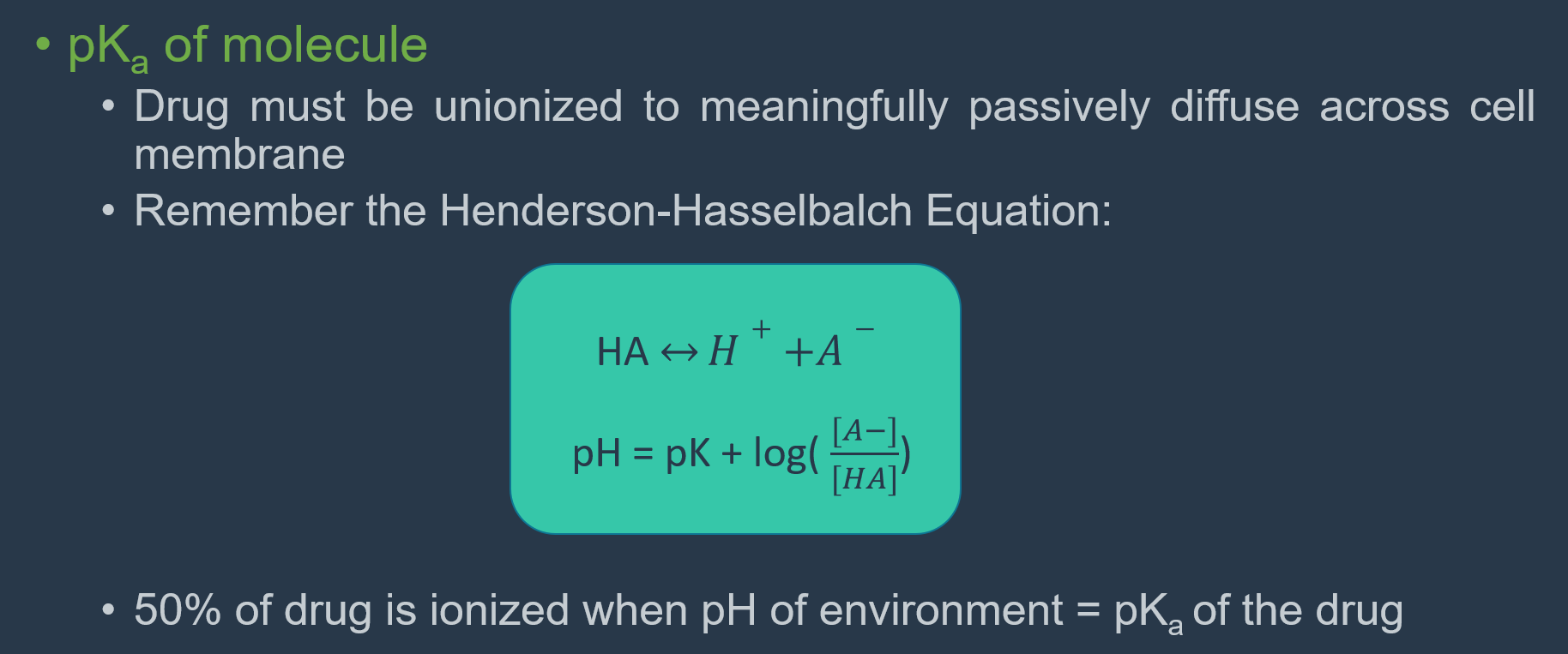
The pKa of a drug is the pH where half of the drug is in the ionized form and half of the drug is in the unionized form
pH of the environment will impact the drug's ratio of ionized to unionized states.
You can use the Henderson-Hasselbalch equation to determine relative concentrations of ionized vs unionized forms at various pH levels. Stomach (pH 1.5-3.5) vs small intestine (pH 6-7.4)
Mechanisms of Absorption
Passive Diffusion
Drug flows down concentration gradient (high concentration to low concentration)
Not dependent on active transport or other mechanisms
Not saturable
May flow through channels or pores
Facilitated diffusion
Transmembrane proteins that facilitate the drugs passage through membrane
Drug flows down concentration gradient
Saturable
Active transport
Selective transport that requires energy (ATP)
Mediated by transmembrane proteins
May go against concentration gradient
Example: P-glycoprotein
MDR1 (P-glycoprotein) – a gene that encodes for a transmembrane protein efflux pump that rids foreign chemicals from cells (moves foreign substances from cytoplasm out of the cell).
These efflux pumps exist in many organs including kidneys and digestive system to rid the body of foreign substances.
Neoplastic cells frequently express this protein, which contributes the cancer's resistance to chemotherapy.