Catapult Pharmacology
Pharmacokinetics and Drug Dosing
Pharmacokinetics and Drug Dosing
Kinetics
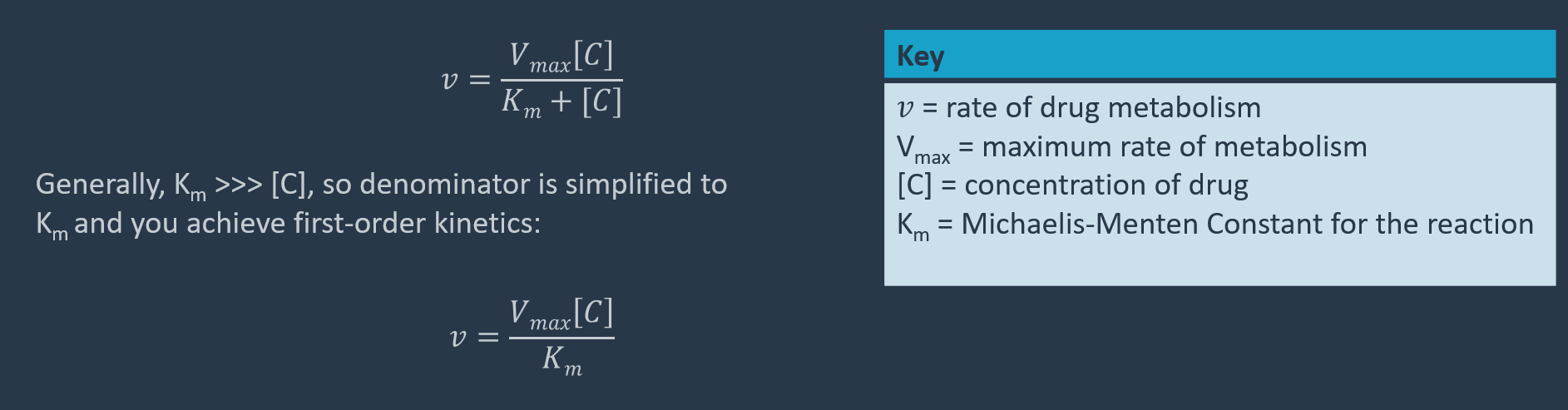
Drugs are metabolized by enzymes, which generally follow Michaelis-Menten kinetics. Michaelis-Menten kinetics is represented by the following equation:
First-Order Kinetics
Most drugs follow first order kinetics. As you can see in the resulting equation above when Km >>> [C], the equation simplifies, and the rate of drug metabolism is proportional to the concentration of the drug.
(Vmax and Km are constants for the reaction and do not change based on the concentration of the drug.)
"What does that mean?"
A: If you were to plot out the concentration of the drug over time, you would see that half of the drug is eliminated over a fixed amount of time (half-life). For example, if at t=0s [C]=0.5 and at t=60s [C]=0.25, you would expect that at t=120s [C] = 0.125 if the reaction follows first-order kinetics.
Zero-Order Kinetics
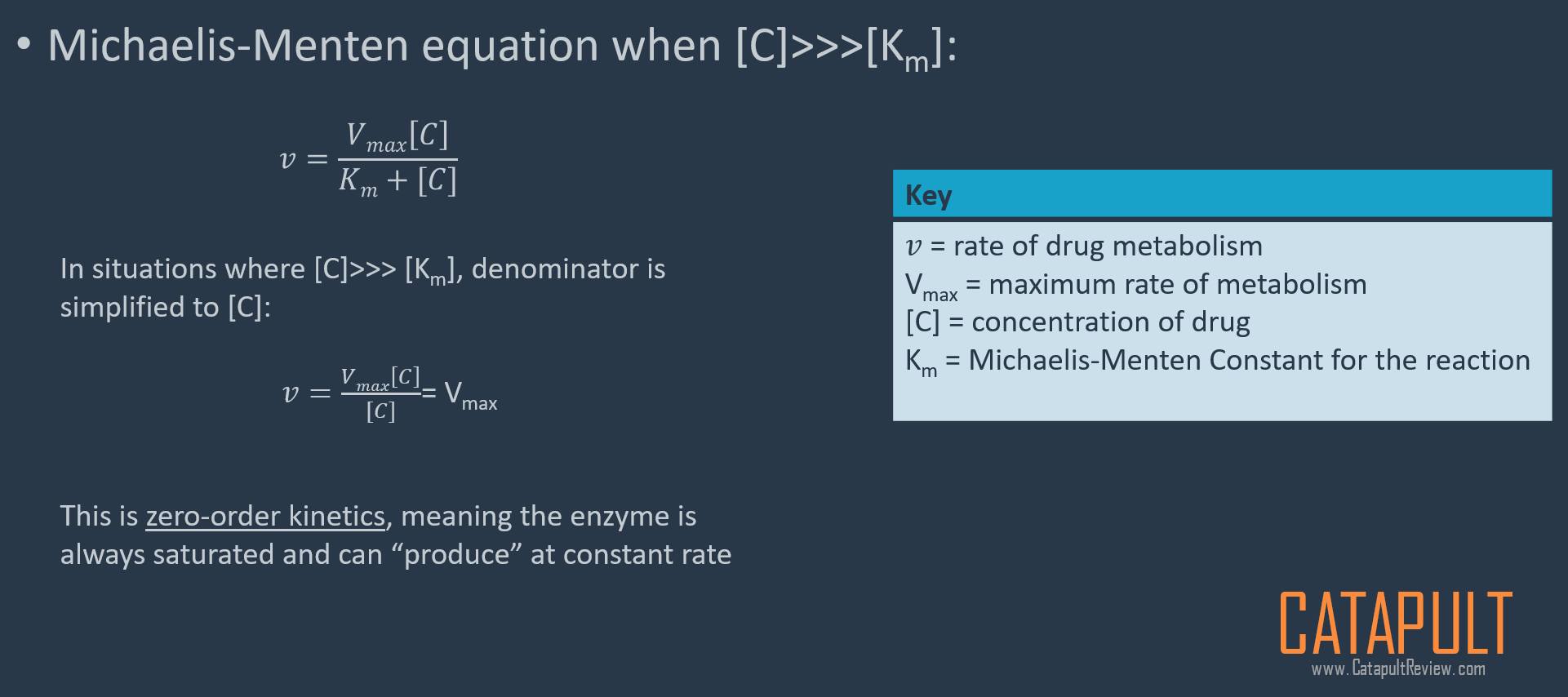
Some drugs exhibit zero-order kinetics. In zero-order kinetics, [C]>>>Km (opposite of first-order kinetics). In this situation the Michaelis-Menten equation simplifies to v=Vmax.
"What does this mean?"
A: If a drug is metabolized by zero-order kinetics, the rate of metabolism does not depend on the concentration of the drug. Vmax for the reaction is a constant, so the rate of metabolism is constant. This results in a fixed amount of drug metabolized over a fixed amount of time.
Comparing First-Order and Zero-Order Kinetics
| First Order Kinetics | Constant proportion of drug eliminated over time |
|---|---|
| Zero-Order Kinetics | Constant amount of drug eliminated over time |
Dosing Regimens
Dosing schedules and methods impact plasma concentration over time. Plasma concentration increases when a drug is administered and decreases as the drug is metabolized and eliminated. These processes can occur simultaneously.
Continuous Intravenous (IV) Infusions
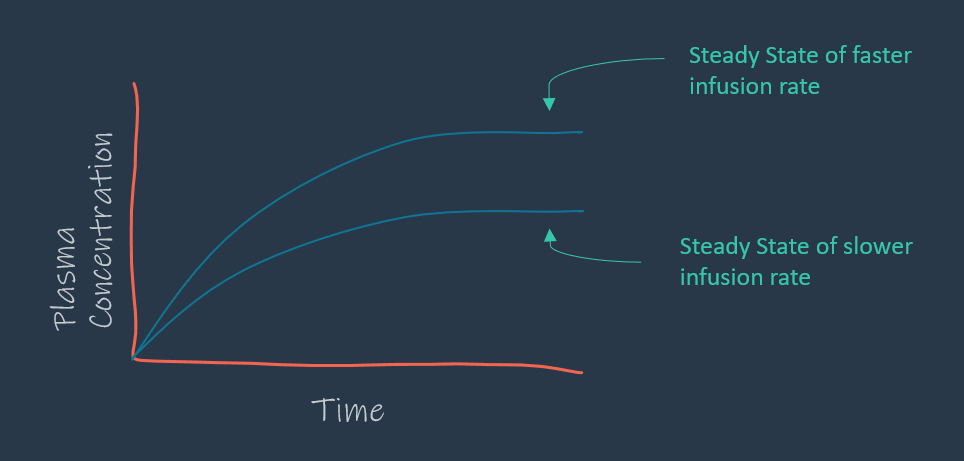
Constant IV infusions result in continuous addition of medication. As mentioned above, drugs are eliminated and metabolized immediately upon the drug being administered. The concentration of the drug reaches a steady-state concentration when the administration rate equals the elimination rate.
The time to reach steady state is dependent on the elimination half-life. A longer half-life increases the time to reach steady state.
The concentration of drug at steady-state is dependent on the infusion rate of the medication.
Intermittent Intravenous (IV) Infusions
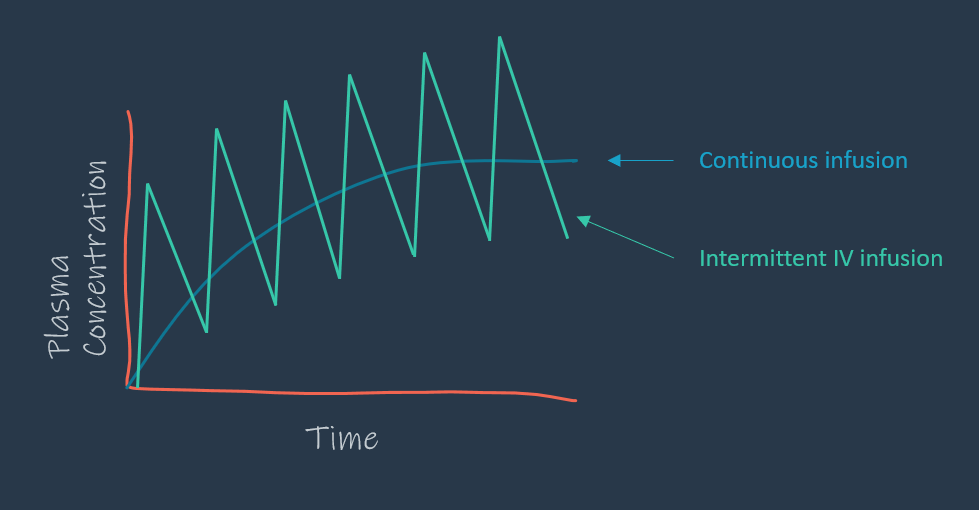
Intermittent IV infusions result in a saw-toothed pattern of plasma concentration. The plasma concentration increases during episodes of administration and falls during the time between doses. Over time, the concentration alternates above and below a steady-state level.
Oral Administration
Oral administration is much more difficult to predict due to the many factors that impact absorption. In general, the plasma concentration of the drug appears in a similar saw-tooth pattern as an intermittent IV infusion.
Dosing Adjustments
Loading Dose - A loading dose (larger initial dose) shortens the time to reach stead state plasma concentration. Useful in drugs with a long half-life. Loading doses are calculated using the following formula (Vd= Volume of Distribution) for IV infusions:
Loading dose = Vd x [Desired steady-state concentration]
Dose Maintenance - Plasma levels of drugs concentrations or surrogate laboratory findings can be used to help in adjusting medication dosing to each patient. For example, the drug warfarin is monitored using the prothrombin test measured as the international normalization ratio (INR). Warfarin is a blood-thinning medication. When the blood is too thin (high INR level), the dosing of warfarin can be reduced to allow the INR level to return to the therapeutic range.