Catapult Pharmacology
Drug Distribution
Drug Distribution
Many factors influence drug distribution. These factors include physical and chemical properties of the drug and the physiology of the patient. The breadth of distribution is quantified by calculating the volume of distribution (Vd).
Biophysical Factors Affecting Distribution
Blood Flow
Tissues receiving higher volumes of blood flow will be exposed to a relatively larger amount of drug.
Capillary Permeability
Capillaries include a circumferential basement membrane. The basement membranes is then either completely or incompletely coated by a layer of endothelial cells.
The level of coverage of the basement membrane by endothelial cells determines the permeability of the capillary. The gaps in coverage of the endothelium are called fenestrations. Fenestrations expose the basement membrane to the flowing blood and compounds in the blood. Capillaries with more fenestrations and fenestrations that are larger in size will be more permeable.
Capillaries in the CNS do not have fenestrations and the endothelial cells are physically connected by tight junctions. The lack of fenestrations and the tight junctions help form the "blood-brain barrier," which significantly limits the compounds that have access to the CNS. Drugs must be lipid soluble or actively transported into the CNS to gain access.
Protein Binding
Drugs that bind plasma proteins (albumin) are not actively available but are released from albumin as the plasma concentration of the drug decreases.
- This effect maintains a relatively stable plasma drug concentration.
Drugs may bind to tissue proteins and act as drug stores.
- Prolongs drug action and may lead to toxicity.
Lipophilic Nature of Drug
Highly lipophilic drugs will readily pass through the cell membrane into the cell by diffusion.
Hydrophilic drugs must pass down concentration gradients through facilitated diffusion or enter the cell through active transport.
Volume of Distribution
The volume of distribution (Vd) is the measure of how much drug is in the body at the measured concentration in the plasma. Volume of distribution is defined using the following formula:

Functional Compartments
Dividing the body into three functional compartments allows one to understand the volume of distribution of a drug. The three functional compartments of the body are:
Intravascular
Interstitial
Intracellular
Drugs isolated to the intravascular space tend to be drugs that are more polarized, protein bound, and larger. Drugs that can move into the interstitial spaces are generally hydrophilic but small and able to diffuse through capillaries. Drugs that move into the intracellular space tend to be more lipophilic and smaller. As a drug moves into more compartments, the Vd increases. Hence, drugs that are lipophilic tend to have larger volumes of distribution.
While these principles are important and allow predictions for the volume of distribution, generally, the Vd is calculated based on the concentration of drug in the plasma at various times, plotted (log of concentration vs time), and the theoretical Vd at time zero is calculated. The dose of the drug in combination with the extrapolated concentration at time zero are then used to calculate the volume of distribution based on the following formula: Vd= Dose/C0. See Figure 1.
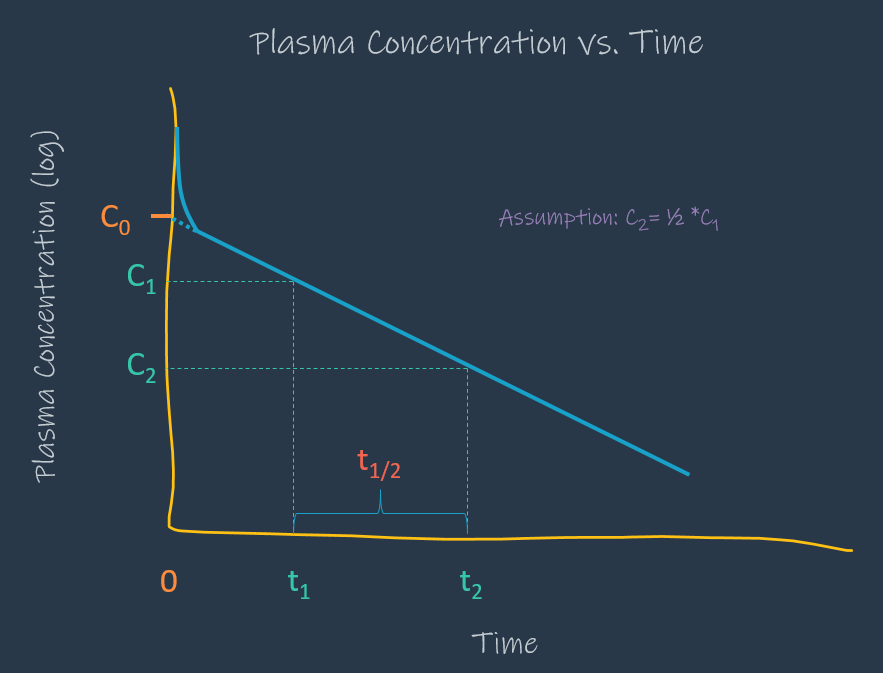
Figure 1 - Volume of distribution (Vd) is calculated by determining the concentration of the drug in plasma at time zero and knowledge of the dose given. Concentrations of the drug are measured at an interval and plotted (log of drug concentration vs time). First-order drug clearance is assumed, which allows a line to be fit to the data and for extrapolation of C0. The dose and C0 are used to calculate Vd using the following formula: Vd= Dose/C0.
The Vd can help indicate the half-life of a drug. Drugs with a high Vd tend to have a longer half-life because they are less concentrated in the plasma and less likely to be delivered to the liver or kidneys where they are metabolized and excreted.